Etymology
Names and history
The same steering-wheel spinner has collected a long list of slang. Most of the names point at speed, risk, or the extra free hand the knob creates.
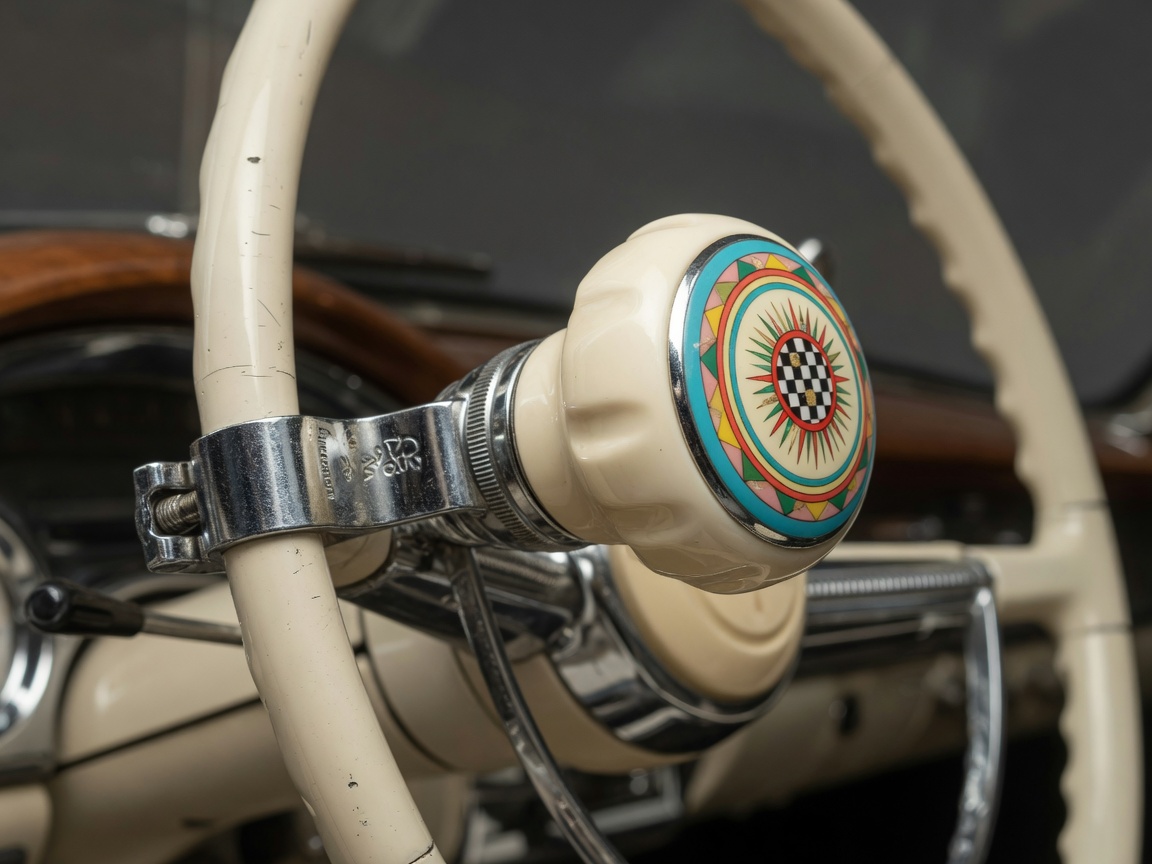
The 1936 spinner knob
The “Steering Wheel Spinner Knob” was invented by Joel R. Thorp of Wisconsin. He filed U.S. patent application serial no. 113,283 on November 20, 1936. The Official Gazette of the United States Patent Office listed the invention on December 7, 1937.
Aftermarket knobs spread on trucks, tractors, and passenger cars in the 1940s and 1950s. They were useful on heavy unassisted steering and, later, became a chrome-and-bakelite styling item.
Brodie knob
Brodie knob (also spelled Brody) refers to Steve Brodie, a New York man in the 1880s who became famous for supposedly jumping off the Brooklyn Bridge and surviving. He did it, the story goes, to win a bet, a saloon, and publicity. The jump has been disputed, but it was reported in the newspapers of the day, and his saloon later displayed memorabilia of the stunt.
“Taking a Brodie” or “doing a Brody” came to mean jumping from a high place, then any reckless stunt. The knob picked up the name because it made flashy, high-speed steering tricks easier — and because misuse could mean a loss of control. Very few people have survived a jump from the Brooklyn Bridge. By that association, the darker slang suicide knob followed.
Suicide knob
Suicide knob is the most common modern search term. Writers have given two related reasons for it:
- A spinner can make it harder to feel the road and easier to oversteer. In an emergency, the knob is a poor substitute for two hands on the wheel.
- If the driver lets go after a turn, the wheel can unwind fast. The spinning knob can strike a knuckle, forearm, or elbow — or catch a sleeve.
The name is folklore, not a legal classification. It is one reason people assume the device is banned. See the state law notes and the safety page.
Necker knob
Necker knob, or necker’s knob, comes from a social use: one hand on the spinner left the other arm free for a date. Necking was 1950s and 1960s slang for caressing a partner on and above the neck, and sometimes for kissing or making out.
Granny knob
Granny knob is a milder nickname. It points at easier, slower-speed steering — parking, turning a tight farm lot, or reducing the effort of a heavy wheel — rather than at stunts.
Knuckle buster
Knuckle buster describes the same unwind problem. After a corner, the steering can spin back through the driver’s hand. The knob, now a hard lump on the rim, can rap the knuckles. The name is still used around farm shops and truck yards.
Spinner knob and wheel spinner
Spinner knob and wheel spinner are the plain product names. Adaptive-driving catalogs usually use spinner knob or steering aid rather than the slang. Medical and mobility versions include ball knobs, tri-pin grips, palm grips, V-grips, and amputee rings.
Lay a Brodie
To lay a Brodie was slang for a half-donut: turn hard while accelerating so the rear tires break loose and the car rotates about 180 degrees. The spinner made that kind of snap-steer easier on snow or dirt.